

Meet Molly. She’s 25 years old and works as a systems administrator at a bank. Molly doesn’t have any buying authority yet, but she’s just been asked to join a committee to recommend how the bank should adopt AI agents. She sees this as an important step toward her goal of becoming a manager in the IT organization.
Molly doesn’t hear much from IT vendors, but she doesn’t think she needs to. She gets much of her advice from influencers she follows on Tik-Tok and Instagram. She also follows several IT vendors on those platforms and likes to share the offbeat and entertaining videos they post.
Molly is part of Generation Z, people born between 1997 and 2012. Gen Z workers comprised about 18% of the U.S. labor force in 2024 and are now a larger population than Baby Boomers, according to the U.S. Department of Labor. They’ll make up 30% of the U.S. workforce by 2030, according to the U.S. Bureau of Labor Statistics. Gen Z was just 6% of respondents to Foundry’s 2023 Role & Influence study, but 15% in 2025.
This is a cohort to be reckoned with. Foundry has been tracking preferences by age group in IT marketing research for several years. An analysis of three years of recent studies reveals that engagement strategies must emphasize speed, new channels, concise content, and emotional tone.
Time is of the essence
Gen Z IT decision-makers move fast and expect vendors to do the same. In the 2024 Role & Influence Study, the group pegged the average buying process at 5.1 months, compared to 6.5 months for Boomers. They were also nearly twice as likely as other generations to say decisions take less than a month.
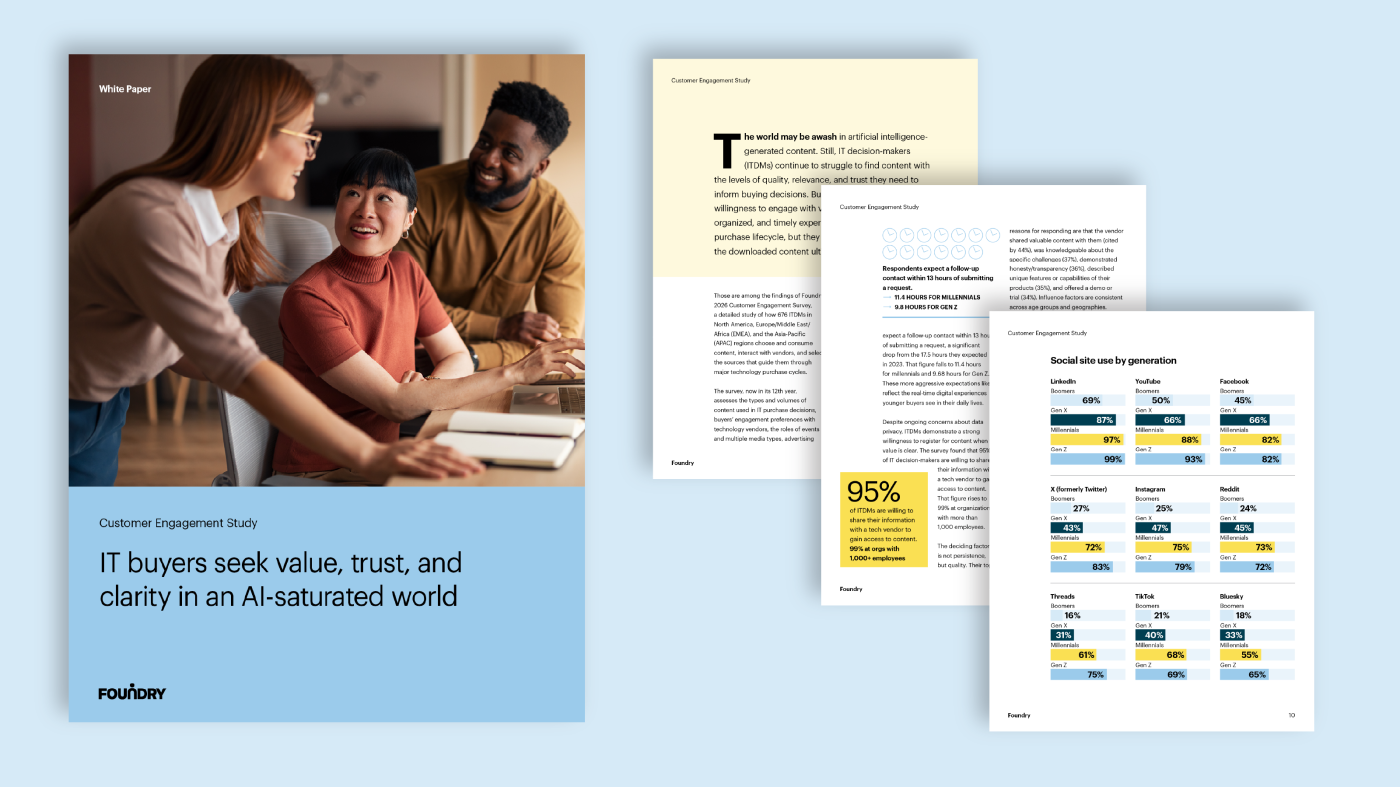
Younger buyers have less tolerance for delay. On average, they expect vendors to follow up on inquiries within 9.6 hours of submitting a request, according to the 2026 Customer Engagement research. That’s six hours faster than Generation X buyers (born between 1965 and 1980), and more than three hours faster than all surveyed buyers.
Interestingly, Gen Z is less concerned about marketing hype; just 19% cite it as a problem compared to 42% of Boomers, according to the 2026 Customer Engagement study. However, they are nearly twice as critical of content overload (32% versus 17%). Having grown up in a media-saturated environment, these younger folks are less impressed by volume than relevance.
Social savvy
Social media has been around since the oldest Gen Z buyers were in elementary school, so it’s not surprising that they rely on those channels for a wide range of information. But their preferences differ markedly from those of their older colleagues.
LinkedIn is broadly important across generations, but its core strength is with older groups. More than 80% of Boomers and Gen Xers consider LinkedIn valuable, compared to only 45% of Gen Z.
Younger buyers lean far more heavily into visual and short-form platforms. According to the 2024 Customer Engagement research:
- 71% of Gen Zers use Instagram compared to 20% of Boomers
- 56% use TikTok versus 7% of Gen Xers
- 93% use YouTube versus 50% of Boomers
Social media is more than a branding channel for this audience. It’s also an essential research tool. While only 5% of Boomers identified social media as a top-three information source for buying decisions, that figure was 33% among Gen Z.
The 2026 Customer Engagement study also found that the youngest buyers are less likely to visit vendor websites, more likely to sign up for newsletters, and even more inclined to purchase through social ads. They also favor AI-powered search experiences and data visualizations more than their older peers, while showing less interest in long-form content like white papers.
Three-quarters of Gen Zers listened to business-related podcasts in the past year, with a strong preference for on-demand formats over scheduled events. They are less likely to watch webcasts, meaning that thought leadership delivered via audio and short-form video can outperform traditional webinars with this group.
Share nicely
Gen Z respondents are more than twice as likely as Gen Xers and Baby Boomers to share content that evokes an emotional reaction, the 2025 Customer Engagement study found. They’re also three times more likely to share entertaining content than Boomers.
Trust and peer recommendations remain central, though. IT decision-makers of all ages are willing to share vendor information as long as they find it valuable. Enabling that sharing through compelling, easily distributable content can extend reach organically.
Purchasing is a collaborative process, and younger buyers prefer to have more voices involved. The average buying committee at the largest companies is 32 people, but in the 2024 Role & Influence study, Gen Zers told us an average of 37 people influence decisions at their companies. Boomers estimated the number at just 16.
This seems odd, given that many of these people work at the same companies. A possible reason: The younger cohort prefers to see more people involved, even if many don’t actually play a direct role in decisions.
Bottom Lines
Here are a few action items we believe marketers should take away from this research.
- Provide materials that are easy to forward internally. Make web and social content easily shareable.
- Provide concise summaries of long-form material.
- Equip your salesforce to respond to inquiries in hours instead of days.
- Hire or designate social media-savvy marketers, particularly those who are fluent in video.
- Emotional authenticity matters. Look for case studies and spokespeople who come across as genuine and trustworthy.
- Invest in native storytelling rather than repackaged advertising
- Enable peer validation and commentary through online communities and events such as videoconferences.
As Gen Z buyers grow in numbers and influence, marketing organizations should optimize for speed, informational value, and authenticity. Building credibility with this rising generation is essential. Relying on legacy playbooks is a ticket to irrelevance.