

AI has long been a central element for PPG Industries, a Fortune 500 company and global supplier of paints, coatings, and specialty materials. PPG’s AI Center of Excellence (CoE) has been on the frontlines of a number of critical initiatives, including marshalling AI to spawn new product formulations and to accelerate the laborious color matching process at scale.
To date, AI projects were managed like most high-profile IT initiatives, with PPG’s CIO balancing both business strategy and technology implementation responsibilities. But the frenzy over Generative AI’s ability to democratize a powerful technology has raised the stakes, adding another dimension to the CIO’s already expansive charter. Today, CIO Bhaskar Ramachandran devotes significant time to educating PPG business leaders on the basics of Large Language Models (LLMs) while managing expectations for exactly how and where GenAI technologies have potential to transform business.
“I didn’t spend much time educating people on an ERP system—they understood it was a system for managing processes whether planning or financial,” explains Ramachandran, also PPG vice president. “But that’s not the case with AI. We’re not talking about a process or a technology that just makes something faster or cheaper. We’re talking about what business might look like while a technology is still immature.”
Despite soaring expectations, AI experience and maturity levels remain at ground level, leaving enterprises hungry for leadership that can set expectations and help cut through the noise. CIOs, who established their stripes as technology-centric business strategists during the pandemic period, are once again commanding the spotlight as companies try to nail down roadmaps and strategies to capitalize on what many are heralding as a make or break AI moment.
According to the 2025 State of the CIO research, which canvassed 906 IT leaders and 250 line of business (LOB) professionals, IT leaders are dialing up a strategic focus this year as they work to parlay the early rush of AI experimentation into enterprise initiatives that produce measurable results. Forty-one percent of IT leaders responding to the 2025 survey characterized their role as strategic, six points higher than the 35% claiming that mantle in 2024. Looking out on a three-to-five-year horizon, more than half (52%) of respondents expect to sustain a strategic orientation with 32% back to focusing on transformational activities and only 16% mired in traditional functional IT duties.
In an era where technology is inextricable from the business, it’s no surprise that CIOs are among the top leaders steering AI’s course.
“In the 1990s, no one questioned whether the CFO role was strategic, and by 2020, no one should have similar questions about the CIO role.”
Bhaskar Ramachandran, Vice President and CIO at PPG
CIO’s strategic AI charter
CIOs are covering the bases as part of their strategic AI charter. Three quarters of respondents to this year’s 2025 State of the CIO research confirmed the CIO is collaborating closely with line of business on AI applications while 71% said the IT department is driving AI adoption in tandem with their business unit counterparts, aligning strategies accordingly.
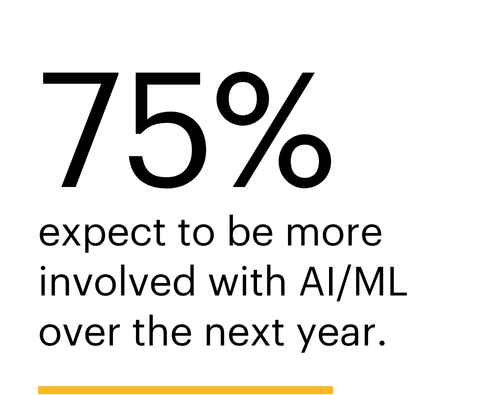
Three quarters of IT leaders expect to become more involved with AI and machine learning over the next year, and for good reason. The CEO’s top priority for IT leaders in 2025 is researching and implementing AI products and projects, cited by 26% of respondents. Last year, the AI agenda was not among the top CEO mandates for CIOs—the directives were to lead digital business and digital transformation initiatives, fortify IT and business collaboration, and focus on security to reduce corporate risk.
CIOs are directing AI investments as part of their AI agenda. Eighty percent of IT leaders and three quarters of LOB respondents confirmed that CIOs are spearheading efforts to research and evaluate possible AI additions to the tech stack. Technology and business leadership is pretty aligned on where to direct those AI technology investments and what initiatives to prioritize. The 2025 State of the CIO found 68% of IT leaders and 69% of LOB respondents in sync on Generative AI adoption strategies and use cases.
Currently, the bulk of AI activity is happening on the inside, aimed at helping companies reimagine their internal business processes. Sixty-nine percent of IT leader respondents to the 2025 State of the CIO survey said AI is being leveraged to automate internal processes to streamline operations and create efficiencies while 62% are embracing AI for customer-facing applications. Whether focused inside or out, the surge of AI activity is already having an impact. More than two-thirds (68%) of this year’s IT leader respondents contend that AI has or is beginning to reshape operations and drive tangible business outcomes.
That’s certainly the case at Tractor Supply Company, where AI has played a role for years, helping to forecast sales and merchandising needs and optimize replenishment of goods. More recently, Tractor Supply has paired GenAI capabilities with headsets to create Hey GURA, a knowledge base, sales, and training platform for employees that serves up product specs, customer recommendations, and other relevant information so they can better assist customers on the floor. Tractor Supply is also applying LLMs to drive insights into team member performance and real-time sales analysis and is starting work on Agentic AI applications to bring automation to core processes like updating and publishing content for new SKUs, according to Rob Mills, executive vice president and chief technology, digital, and corporate strategy officer for the firm.
Given the weight of AI’s impact, Mills views being an advocate and champion for the technology as a major focus of his role going forward. He is committed to acclimating both business leaders and frontline employees to new AI technologies, emphasizing the importance for all employees to understand potential opportunities. “Team members hear about AI, but they don’t necessarily know what it means for them,” he explains. “It’s my responsibility to make sure they understand why they should care about AI and how it will make their job easier and more accurate. We’re not leading with technology first—we are leading with the business need and showing how we can leverage emerging technologies to ultimately get things done efficient and faster.”
IT investments take aim at revenue growth, customer experience
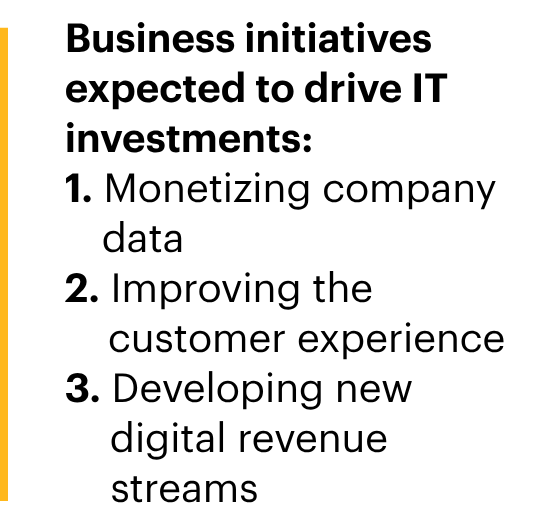
While AI is the headliner this year, CIOs are immersed in other strategic business initiatives aimed at boosting revenue growth and improving customer experience. According to the 2025 State of the CIO survey, monetizing company data was the top business imperative for 38% of respondents followed by improving customer experience (35%) and developing new digital revenue streams (32%).
Companies are leveraging data and analytics to analyze customer needs and behaviors, cited by 43% of this year’s respondents. AI/ML and automation are another major enabler, with 41% tapping the technologies to streamline support and customer service interactions, the 2025 research found.
Webster Bank has taken a very deliberate approach to acquisitions these last few years as part of a business strategy to grow and diversify deposits. The bank is investing in technology companies and digital products that will streamline banking services for customers and build out a suite of diversified deposit products. Given the strategic nature of the acquisitions, CIO Vikram Nafde has been at the forefront, accessing potential candidates to see if they are the right fit, evaluating the technology stack, as well as spearheading work to address potential integration challenges.
“As opposed to acquiring branches and physical assets, we are acquiring technology-enabled companies, and CIOs play a huge role,” explains Nafde, also an executive vice president at Webster Bank.
“CIOs are uniquely positioned to not only understand the moment and what technology can do for the company, they can also lead the charge in terms of finetuning strategy and educating the board.”
Vikram Nafde, Executive Vice President and CIO at Webster Bank
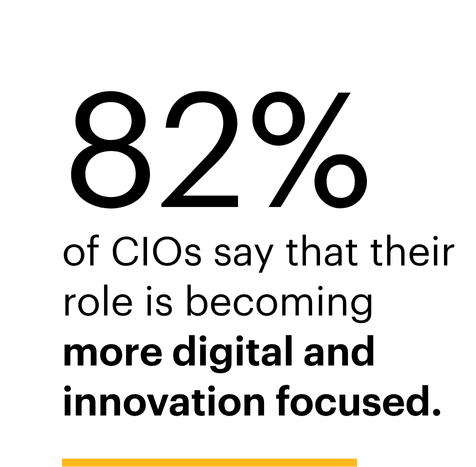
Like Nafde, State of the CIO respondents continue to report a highly digital and innovation-focused CIO charter, cited by 82% of IT respondents and 76% of LOB participants. Eighty-two percent of respondents confirmed CIOs are taking the lead on digital transformation initiatives, more so than their business counterparts. In roughly a quarter of companies (26%), the CIO holds sole responsibility for all digital transformation decisions and initiatives. At 29% of responding companies, ownership of the digital transformation agenda is distributed among all leaders.
Much like last year, IT budgets are holding strong despite global economic uncertainties. Budget increases were on the docket for 65% of this year’s respondents with roughly a quarter (24%) anticipating funding to remain the same. On average, respondents expect to see a 6.89% bump in IT spending in 2025, primarily driven by the need for additional investments in AI/ML projects, products, and services.
In fact, AI/ML was the most high-profile area of technology investment this year, at 42%. Outside of AI/ML, companies were directing IT budgets to security and risk management technologies (34%) and data/business analytics (31%).
Pacific Northwest National Laboratory (PNNL)’s AI journey is all about reimagining the “art of the possible,” including how the technology can streamline and uplevel the software development process, according to Brian Abrahamson, associate laboratory director and chief digital officer for computing and IT. The team is leveraging AI to help write user stories and generate code. It’s also using AI to develop synthetic data to drive testing and user documentation. “We are retooling and reskilling in software development so we can create more capacity to apply AI,” Abrahamson says. “It’s not just AI-assisted coding, but to the left and the right of the Software Development Lifecyle (SDLC).”
On Abrahamson’s watch, PNNL is also continuing to modernize IT architecture and infrastructure in the cloud and make on-going investments in cybersecurity technology. Many 2025 State of the CIO respondents are in the same place. CIOs are spending time mapping out modernization strategies for infrastructure and applications (32%), ensuring IT initiatives are aligned with key business goals (31%), and redesigning business processes (26%). Leading change efforts was also part of the territory, cited by a quarter of respondents.
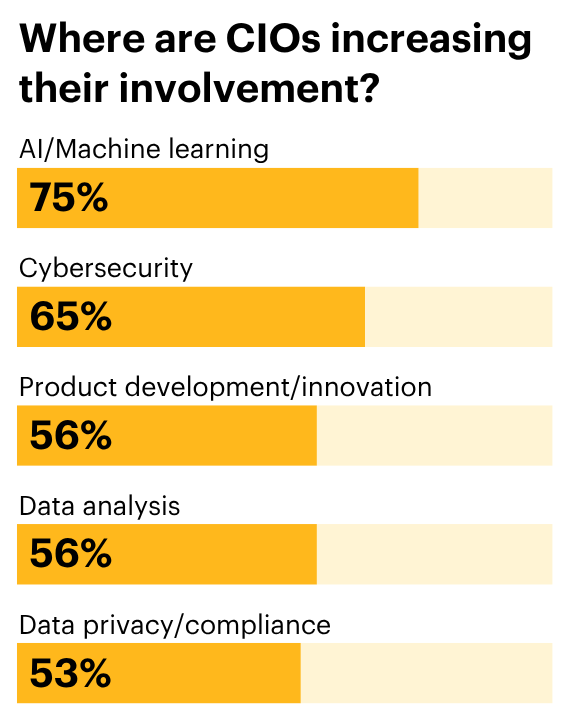
Strategy work consumed a fair amount of time CIOs’ time this year, including driving business innovation (27%), developing and refining business strategy (27%), and studying market trends and customer needs to identify and flesh out new market opportunities (22%). While respondents expect to devote even more time to business strategy over the next few years, critical functional duties like security management will need to remain a high priority. According to the survey results, over the next year, CIOs will spend more time on AI/ML related initiatives, at 75%, followed by cybersecurity (65%), product development and innovation (56%), and data analysis (56%).
Cybersecurity, talent gaps remain critical challenges
Despite investments in state-of-the-art tools and efforts to mature their cybersecurity posture, CIOs continue to cite cybersecurity as their No. 1 challenge. In fact, addressing changing business conditions (43%) and mitigating security threats (33%) took up a good portion of the CIO agenda, commanding time that could be devoted to higher-value activities.
An increasingly sophisticated threat landscape, bolstered by bad actors’ use of AI, keeps cybersecurity a perennial moving target. In light of those complexities, it’s essential CIOs promote strong cyber hygiene, formalize governance, ensure disaster recovery practices are in place, and do whatever else it takes to ensure the organization is ready. “The one thing that keeps me up at night is cybersecurity,” says PPG’s Ramachandran. “There are so many unknowns, and we operate in so many countries—that’s the challenge.”
Beyond staying on top of cybersecurity, attracting and retaining the right talent remains an on-going struggle for CIOs to grapple with. More than half of this year’s respondents (54%) said dealing with staffing and talent matters took time away from more strategic innovation pursuits.
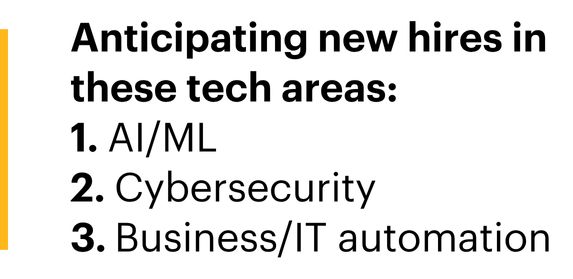
Given the AI-dominant agenda, organizations are ramping up hires versed in AI and machine learning skill sets, cited by 36% of this year’s respondents. Building out a talent bench flush with cybersecurity expertise (34%) and business/IT automation (25%) prowess is also part of the next six-to-12 month hiring plan, respondents said. While there are clearly-defined skill set needs, 2025 State of the CIO respondents anticipate difficulties finding the right talent. Specifically, 38% of respondents said they expect trouble sourcing candidates versed in AI/ML (38%), cybersecurity (33%), and data science/analytics (21%).
In addition to the fundamentals, including cybersecurity and modern tech stack expertise, IT must develop a basic business orientation among staffers to ensure the organization can continue to create value. Cultivating individuals who have an understanding and can speak the languages of both business and technology help establish the credibility IT organizations need going forward.
At Cummins Inc., one of the main priorities for 2025 is ensuring the IT organization is stacked with right complement of skills, for today and for the future, according to Earl Newsome, vice president and CIO for the $30 billion global manufacturer of diesel and alternative fuel engines, generators, and power systems. “We are focused on futureproofing the IT organization so we can win today and get our fair share in the future,” says Newsome. “That means understanding what AI and analytics skills we need, building the right skills to be a product owner, and developing UX and customer experience capabilities for the products we create.”
CIO outlook: Rising to meet new challenges
As companies reevaluate and reimagine business strategy for AI, the CIO role continues to gain ground. Three quarters of IT and 69% of LOB respondents said the combination of economic factors and growing enterprise visibility continue to elevate the CIO role. With their stature on the rise, CIOs are also getting more comfortable with multi-title roles and non-technology responsibilities. On average, CIOs are fielding 1.8 positions, and the vast majority of CIOs (77%) have successfully cultivated a strong educational partnership with the CEO and board of directors.
CIOs are also actively embracing a changemaker role with 81% championing both business and technology initiatives, many tied to strategic use of AI. Given the requirement to focus on both business strategy and technology implementation, more than three quarters of this year’s respondents (76%) say that striking the right balance between business innovation and operational excellence remains an on-going challenge.
With the stakes of this AI era so high, IT leaders are bound to get caught up in the hype and enthusiasm as they evaluate new opportunities and navigate the still unfolding landscape. Managing expectations both up and down all layers of the organization will be essential for maximizing strategic use of AI.
“Everyone is scrambling now with how to transform the business, but it’s still a multi-year journey that won’t happen overnight,” cautions PNNL’s Abrahamson. “Poorly managed expectations will lead to disillusionment and frustration. While CIOs will want to invest in AI, it can’t become such a distraction that they lose focus on the fundamentals of IT and managing the business.”